


Agricultural University of Athens - Evaluation of the New Dietary Guidelines for Americans: Positive steps, but also serious concerns
Agricultural University of Athens - Evaluation of the New Dietary Guidelines for Americans: Positive Steps, but Also Serious Concerns
The new 2025–2030 Dietary Guidelines for Americans, recently issued by the U.S. Government, constitute an important public health tool, as they influence nutrition policy, the food system, and the consumer choices of millions of citizens. Their overall assessment highlights both positive elements and critical points that raise scientific concerns, as noted by the Laboratory of Dietetics and Quality of Life of the Department of Food Science and Human Nutrition at the Agricultural University of Athens.
Among the positive aspects are recommendations that move in the right direction by emphasizing the consumption of minimally processed, nutrient-dense foods and the reduction of added sugars, sodium, and saturated fat intake. Dietary patterns based on whole, natural foods and reduced reliance on high consumption of ultra-processed foods and sugar-sweetened beverages have been shown to provide clear public health benefits, particularly in populations with a high prevalence of obesity and chronic diseases, as is the case in the United States.
The clear recommendation to reduce the consumption of highly processed foods, excessive saturated fat, sodium, and added sugars constitutes a fundamental and necessary public health intervention.
At the same time, there are points of concern arising from the new positioning. Despite the positive elements, the new guidelines include recommendations that raise serious questions. More specifically:
- While a reduction in saturated fat intake to below 10% of total energy intake is recommended, the simultaneous promotion of red meat, full-fat dairy products, and butter moves in the opposite direction and makes this goal extremely difficult to achieve. Particularly problematic is the absence of clear reference to and restrictions on processed meat products, such as cold cuts.
- The recommendation to increase protein intake is based on literature that is incomplete and does not align, on the one hand, with the needs of the general population but rather with guidelines for physically active individuals, and on the other hand, with the principles of the Mediterranean Diet, where recommended protein intake is lower and comes mainly from plant sources and fish.
- According to the new guidelines, the lower limit for carbohydrate intake (130–150 g/day) and the recommended intake of dietary fiber (~30 g/day) are difficult to achieve, creating practical and nutritional inconsistencies with currently accepted scientific evidence.
- There is a complete absence of any reference to hydration and total fluid intake, a fundamental element of health and well-being.
- There is no reference whatsoever to the sustainability of dietary choices. On the contrary, encouraging increased consumption of red meat, particularly beef, may increase greenhouse gas emissions, such as carbon dioxide and methane, further exacerbating the climate crisis.
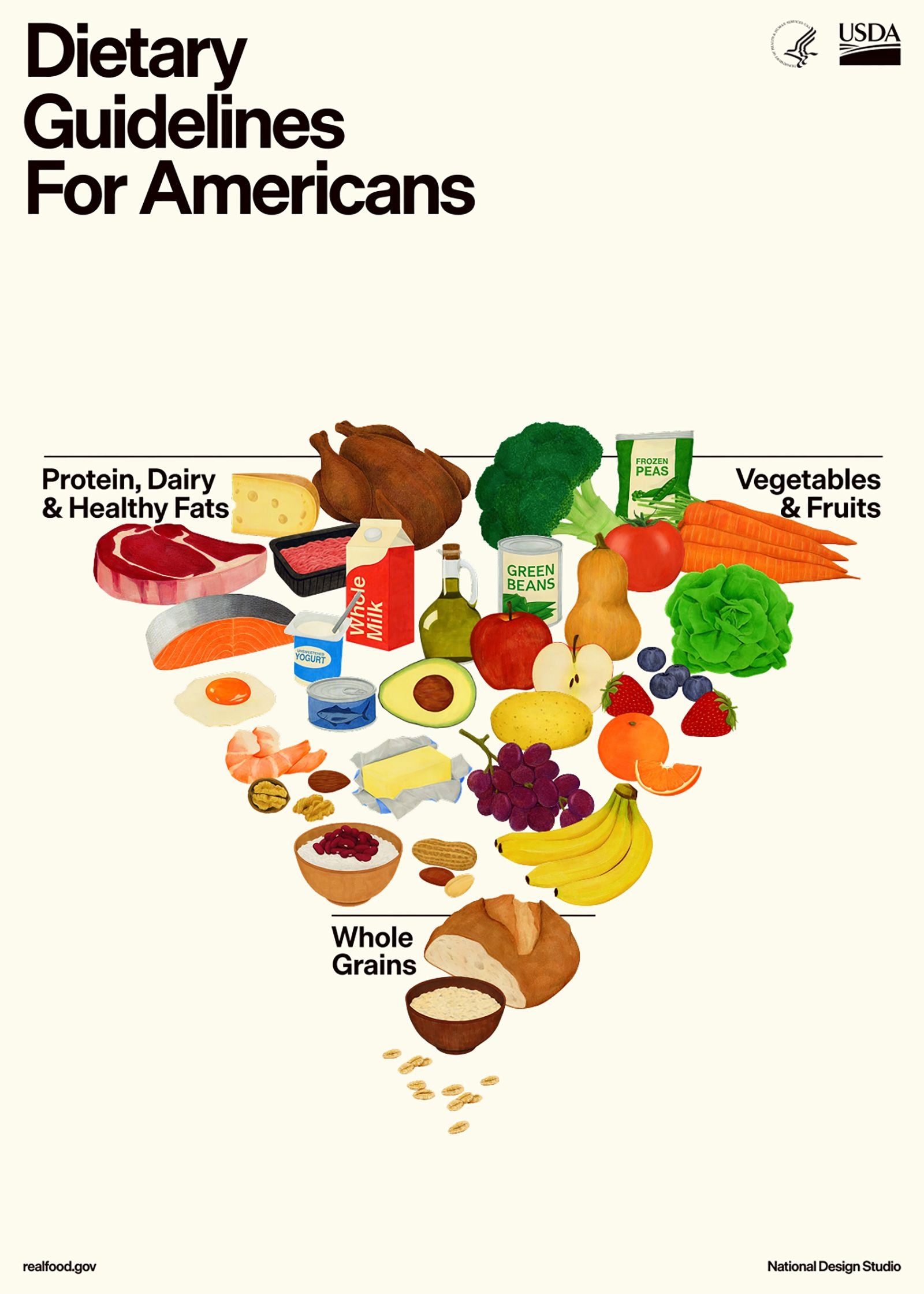
- The way the recommendations are visualized may convey misleading messages to consumers. In contrast to the Greek food pyramid, where red meat is placed at the top and minimally processed grains at the base, the inversion observed in the new American guidelines may lead to the mistaken impression that high consumption of red meat is required and that whole grains should be strictly limited.
Furthermore, issues of scientific process and transparency are raised. Regarding the process followed in formulating the recommendations, questions arise about its reliability, given that it deviates from internationally established scientific procedures for setting dietary guidelines. This led the American Society for Nutrition to highlight a lack of transparency concerning the methods, approaches, objectives, and timeline of the new recommendations.
In conclusion, reducing the consumption of highly processed foods, sodium, and added sugars is a correct and necessary step, particularly in a country where the intake of these components is significantly higher than in Greece. However, several of the new recommendations raise scientific concerns and are not consistent with the principles of the traditional Greek Mediterranean Diet, which remains one of the most scientifically well-documented dietary patterns worldwide in terms of health promotion as well as sustainability.
