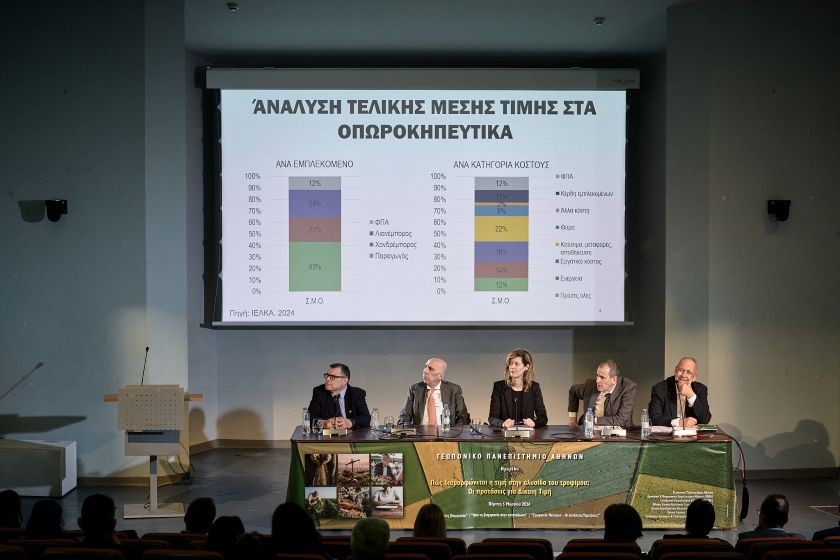
Agricultural University of Athens – Key Conclusions of the Conference “How Prices Are Formed in the Food Supply Chain – Proposals for Fair Pricing”

Strengthening cooperatives, more precise application of fertilizers and agricultural inputs, the creation of a national system of strategic food reserves, and rapid-response mechanisms during crisis periods to ensure food security, as well as the establishment of a Land Bank, were among the proposals presented at the Conference organized on March 5 by the Agricultural University of Athens with the participation of representatives from organizations involved in the food supply chain.
At the same time, the need for a Price Observatory and for strengthening the legal framework to address profiteering was highlighted, along with the reinforcement of traceability tools to limit the phenomenon of falsely labeling imported products as Greek (“Hellenization”), as well as the improvement of transport infrastructure.
More specifically, the conference highlighted that achieving fair pricing within the agri-food chain requires a combination of institutional, technological, and organizational interventions. First, the need to strengthen the creation and operation of healthy agricultural cooperatives was identified. Such cooperatives can help improve control over production costs, enhance the bargaining power of producers in the market, and promote education and the adoption of modern technologies. At the same time, particular importance lies in the use of technologies that reduce input costs, such as the more precise application of fertilizers and other supplies, limiting losses and increasing efficiency.
The need to create a national system of strategic food reserves and crisis-response mechanisms was also emphasized in order to ensure food security. Another important tool is the restructuring of crops toward productive and economically sustainable models for farmers. In this context, increasing overall production could be supported through the creation of a functional Land Bank, primarily accessible to young farmers and not constrained by financial schemes that limit the agricultural use of land.
Regarding market operation, it was noted that addressing profiteering cannot be effectively achieved with the current legal framework, and that greater emphasis should be placed on combating unfair commercial practices. At the same time, traceability tools must be strengthened in order to limit cases of product “Hellenization,” particularly in an international environment of expanding trade agreements, such as those with Mercosur countries or India. In this direction, an effective Price Observatory could play a decisive role in promoting transparency and restoring trust within the agri-food chain.
Finally, it was underlined that fair pricing depends not only on production and market regulation but also on consumer behavior. Consumers need to better recognize the available options and the real value of products. Improving transport infrastructure can also contribute to reducing the final cost of food. At the same time, the continuing decline in agricultural activity risks developing into a serious social problem for the Greek countryside. In this context, tourism emerges as an important opportunity for the “internal export” of Greek food products, particularly when combined with certified recognition of their high quality and clear communication of this value through packaging and product promotion.
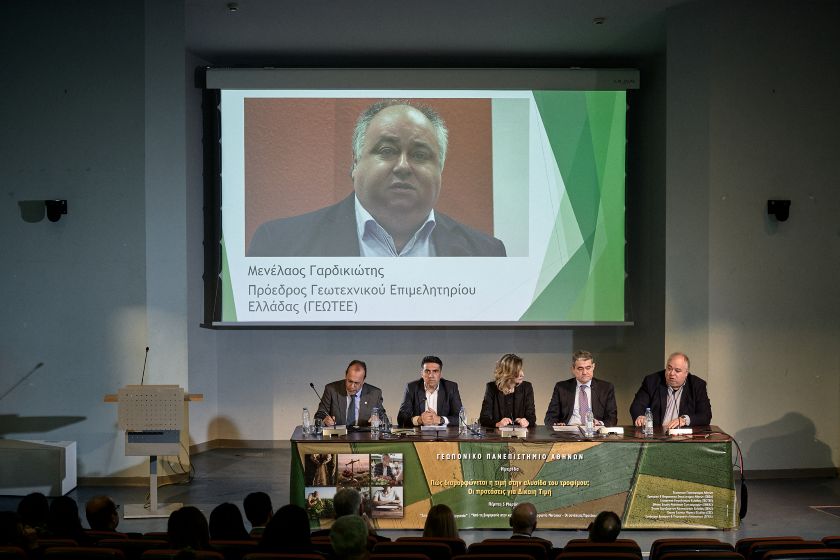
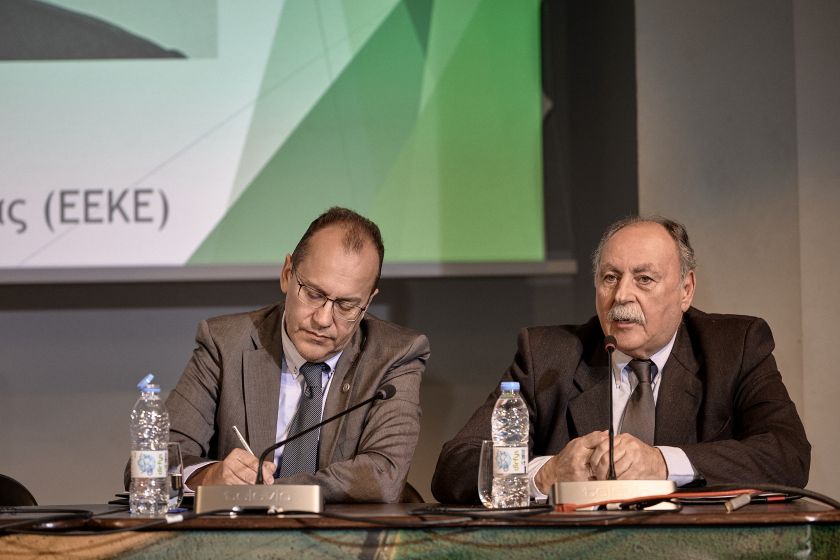
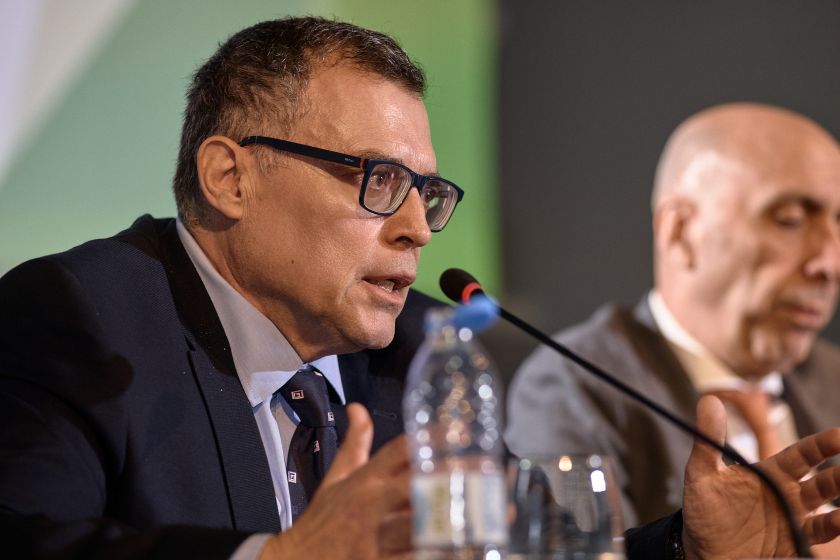
Participants in the conference included Pavlos Satolias, President of the National Union of Agricultural Cooperatives of Greece (ETHEAS); Menelaos Gardikiotis, President of the Geotechnical Chamber of Greece (GEOTEE); Dimitrios Rousseas, President of the Hellenic Fertilizer’s Association (SPEL); Ioannis Bratakos, President of the Athens Chamber of Commerce and Industry (ACCI); Konstantinos Avramis, representative of the Hellenic Association of Supermarket; Apostolos Raftopoulos, President of the Union of Working Consumer of Greece (EEKE); Panagiotis Kalofonos, economist and scientific associate of the Union of Working Consumer of Greece (EEKE); and from the Agricultural University of Athens (AUA), Professor Spyros Kintzios, Rector of AUA, Professor Dimitris Bilalis, Head of the Department of Crop Science, and Professor Antonis Rezitis, Dean of the School of Applied Economics and Social Sciences. The conference also invited representatives from EFET, ESYF, and SEVT.
Opening remarks were delivered by Vangelis Efthymiou, Deputy Secretary of the Agricultural Development and Food Sector of PASOK; Vasilis Kokkalis, Member of Parliament and Head of the Agricultural Development and Food Sector representing SYRIZA–Progressive Alliance; and Nikos Kakavas, President of the Association of Public Sector Geotechnical Scientists.
Selected excerpts from the speakers’ statements
Dimitris Bilalis, Professor, Head of the Department of Crop Science, Agricultural University of Athens
We experience the climate crisis every day. Major damages usually occur in summer and spring crops—those that are also more strategic (cotton, tobacco, maize, sunflower)—where reduced yields and increased production costs are observed. When we try to maintain certain existing crops using the same production system under conditions of climate change, the only result is an increase in maintenance costs. The same applies to crops themselves.
Crops are “migrants”; they move northwards, following the climate. For example, cotton used to be cultivated only as far north as Farsala. What we need to do is become more flexible and accept the development of new crops or new varieties of existing crops.
Pavlos Satolias, President of the National Union of Agricultural Cooperatives of Greece (ETHEAS)
We have the farmer, the producer, the processing industry, sometimes another intermediary, then retail, and finally the consumer. These two ends of the chain—the producer and the consumer—are weak and therefore under significant pressure. We see an unequal distribution of profitability.
Greece is among the countries with the smallest farm holdings. Of course, this is a disadvantage. However, we also have an advantage: we can produce—and in many cases do produce—excellent products. Our main competitive weapon is not quantity but quality. Recently, in many cases, we have started to capitalize on this advantage.
Opportunities are emerging. Companies and cooperatives are making use of them, and our products are gaining a place in international markets. A characteristic example is that exports have reached nearly €9 billion over the past three years. All of this is achieved through cooperatives. There is no other way.
Menelaos Gardikiotis, President of the Geotechnical Chamber of Greece (GEOTEE)
We do not currently have a sustainable Greek agriculture, which is why we see abandonment of the countryside and declining interest among young people in rural life.
As we often say at the Geotechnical Chamber, Greece does not need mass agriculture—it needs unique agriculture.
Greece must become a country of nutritional excellence. Its unique products with high nutritional value should be highlighted. Therefore, we need two things: first, to discuss how to reduce production costs; and second, equally important, how to increase the income that Greek producers receive for their work.
Dimitrios Rousseas, President of the Hellenic Fertilizer’s Association (SPEL)
Europe and Greece lack fertilizer raw materials, and we also lack energy, which is the most important input for producing nitrogen—accounting for more than 40–50% of fertilizer consumption. We depend on others for these raw materials, meaning that we face costs we cannot influence.
What has been particularly impressive in recent years is the development of technologies in the fertilizer sector and the application of technologies in products aimed at reducing losses.
Therefore, the two main pillars we must work on are: first, increasing fertilization efficiency; and second—closely related—enhancing the value of the produced product by improving its qualitative and quantitative characteristics through fertilization.
Antonis Rezitis, Professor, Dean of the School of Applied Economics and Social Sciences, Agricultural University of Athens
A structural problem of Greek agriculture is the small size of land holdings. When farms are small, farmers lack bargaining power.
The agricultural sector must understand that farmers need to form cooperatives and producer groups in order to negotiate better prices for their products within the supply chain. When the other links in the chain are stronger, it is natural that they will try to capture a larger share of the profit.
Therefore, strong cooperatives and transparency are needed. There must be transparency in pricing. The government should play a role here through the Competition Commission, the Ministry of Commerce, and the Ministry of Agriculture, ensuring oversight of how products are priced across the supply chain.
Research, cooperation, and goodwill are necessary to move forward. Another issue is transport costs in Greece and the connection between ports, airports, and other infrastructure. Without transport infrastructure, how can production and trade costs be reduced?
Ioannis Bratakos, President of the Athens Chamber of Commerce and Industry (ACCI)
Personally, I support the free market and an open market. Although I fully agree with price transparency, I do not agree with market interventions. I believe that the market itself—an organized market, an educated market, and an informed consumer system—can reduce final prices.
Regarding mechanisms for monitoring high prices, there are already institutions in place. We often talk about price observatories, price repositories, value repositories, and data repositories. I am not entirely convinced that these will be effective. I believe the market itself can determine the mechanisms for monitoring prices.
Therefore, what is needed is an organized and well-trained system for conducting inspections. The Hellenic Competition Commission has already carried out inspections and has not identified any issues.
Konstantinos Avramis, Representative of the Hellenic Association of Supermarket
The profit margin in supermarkets in 2024, based on financial statements and tax declarations, stands at 1.65%. I am referring to the net profit of the consolidated balance sheets for each supermarket company in Greece. As you understand, 1.65% is a very low profit margin, and this applies to the entire food sector.
In Greek supermarkets, transparency is extremely important from start to finish because costs and planning are determined along this chain as well. Regarding traceability, many supermarkets already use modern systems, including mobile applications that allow products to be scanned so consumers can see where the product comes from and even when it was harvested from the tree.
Apostolos Raftopoulos, President of the Union of Working Consumer of Greece (EEKE)
For meaningful consumer protection, interventions are needed at four levels.
First, digital and mandatory real-time traceability. Every product batch—especially in sensitive sectors such as milk, meat, honey, and legumes—should be recorded on a unified digital platform from the production stage to the retail shelf. Invoices, transport data, and quantities should be interconnected so that inconsistencies can be detected immediately rather than retrospectively.
Second, data cross-checking and targeted inspections using artificial intelligence. For example, if quantities of Greek products are declared that exceed the country’s total domestic production, the system should automatically trigger the inspection mechanism.
Third, inspections must be unannounced, frequent, and accompanied by reasonable and enforceable sanctions. Administrative fines should aim at immediate collection, without the possibility of appeals, and violations should be publicly disclosed for transparency.
Fourth, strengthening certifications and origin labeling.
Panagiotis Kalofonos, Economist and Scientific Associate of the Union of Working Consumer of Greece (EEKE)
The problem we face as consumers concerns who the consumer actually is. According to the Bank of Greece, 71% of the Greek population has deposits of less than €1,000. An additional 12% has deposits between €1,000 and €5,000. This shows that purchasing power is very limited. At the same time, there is the issue of very low wages and the lack of market support during the years of the financial adjustment programs. As a result, consumers’ disposable income has been significantly pressured.
There are no adequate state entities or public bodies that should oversee both product quality and the way prices are formed from the field to the retail shelf. In addition, there are no records of national reserves. In Germany, for example, they measured their forest resources and recorded that they had 317 million trees. They knew exactly how many trees they had. In Greece, do we know how many olive trees we have?
Spyros Kintzios, Professor, Rector of the Agricultural University of Athens
The issue of the Mercosur agreement is particularly timely.
At the European level, among all reference laboratories—which are very well equipped and capable, in the best cases, of detecting more than one thousand different substances or pesticide residues—no more than about 130,000 samples are tested annually. This number represents a drop in the ocean compared to the food samples circulating within the European Union—especially considering the expected surge in imports from Mercosur countries. We need to establish and develop many more testing laboratories, which requires serious investment from both the state and the private sector.
Traceability is not only a matter of labeling. Of course, labels are very important, but state inspections are also necessary. We often hear from the Hellenic Food Authority and ELGO that there are shortcomings in this process. The technological tools already exist—the Agricultural University of Athens and other institutions have developed methods for testing product authenticity. Authenticity is crucial, as is labeling that highlights the health-protective and other beneficial properties of domestic products.